Posts

Showing posts with the label Sherman County

Continue to Stand in the Gap: Sherman County

Image
Grass Valley Cemetery, Sherman County, OR Again I say to you that if two of you agree on earth concerning anything they ask, it will be done for them by My Father in heaven. For where two or three are gathered together in My name, I am there in the midst of them. Matthew 18: 19-20 Coming into Sherman County we are once again in one of the least populated counties in the state, a county bordered by three rivers, the John Day, Deschutes, and Columbia, and known for wheat farming and windfarms. Biggs Junction, a stopping place along the Columbia and I-84, is probably the most familiar place in Sherman County, but going south along Highway 97 travelers encounter the towns of Moro – the county seat – and Wasco, the biggest town in the county. You can read more about the early history and the early churches of Sherman County here , here , and here . Sherman County, OR Sherman County is one of the dwindling number of Oregon counties operating under the County Court system with two commiss...
Praying for Those in Authority: Sherman County

Image
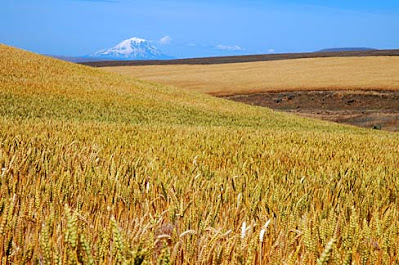
Sherman County with Mt. Adams For the Lord your God is bringing you into a good land, a land of brooks of water, of fountains and springs, that flow out of valleys and hills; a land of wheat and barley… Deuteronomy 8:7-8 Around 1958 a man named Giles French published the book The Golden Land: A History of Sherman County, Oregon . He wrote: The land that lies between the Deschutes and John Day rivers and north of township five south of the base line in Oregon is Sherman County. It slopes gently north to the Columbia River on what is called by geologists the Shaniko surface…Because of the deep gorges of the Deschutes and John Day rivers running north to the Columbia, Sherman County is a geological and geographical entity. The canyons make it to a marked extent a social and political entity as well. Sherman County, Oregon By the late 1880s the Willamette Valley seemed pretty settled and crowded to those seeking wide open spaces, so restless settlers from the west began moving inland, ...

A Deeper Look: Sherman County

Image
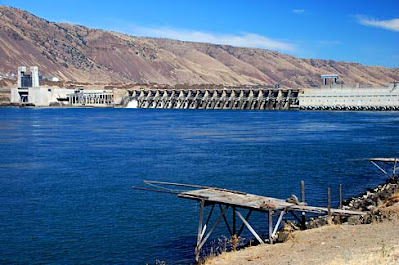
John Day Dam, Sherman county. Fishing platform For since the creation of the world God’s invisible qualities—his eternal power and divine  nature—have been clearly seen, being understood from what has been made, so that people are without excuse. Romans 1:20 On our trip to Hermiston last week we drove through Wasco County, then Sherman , which was once part of Wasco. When Wasco was formed in 1854 it was the largest county ever formed in the United States and stretched from the Washington border to the California border, and from the Cascade to the Rocky Mountains. 17 Oregon counties were later created from it, including Sherman in 1889. Moro is the county seat. In the 1880’s there was a “reverse migration” of settlers who arrived in the Willamette Valley only to find the best land already taken. They moved east and began farming and ranching on the dry eastern side of the Cascades. Some immigrants just stopped there and didn’t go on to the western side of the mountains. Enough...

Praying for Oregon Couties: Sherman

Image
Sherman County Wind Turbines He let loose the east wind from the heavens and by his power made the south wind to blow. Psalms 78:26 As you drive I-84 along the Columbia River going east, Sherman County is next after Wasco County and was, in fact, created out of a portion of Wasco County in 1889. It was named after the Civil War general, William Tecumseh Sherman. I associate Sherman County with Biggs Junction, a “census-designated place” at a crossroads where you can turn south onto US 97 to reach the interior of the county and the incorporated towns of Wasco and Moro, or turn north to cross the Columbia into eastern Washington. While we often stop for lunch and/or gas there, I don’t recall ever turning south at Biggs Junction. We are usually traveling to visit family in Washington, and cross the Columbia there on the Sam Hill Memorial Bridge. The pioneers on the Oregon Trail did turn south, though, some electing to not continue on up the Columbia to the Willamette Valley, instead...